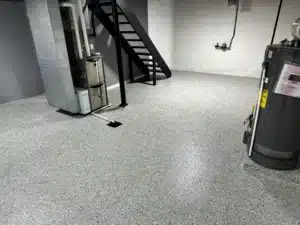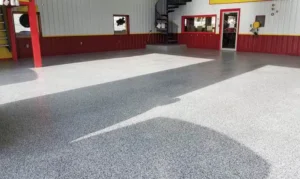

When people ask about driveway coating vs sealing, the short version is this: sealing is a thin liquid barrier that soaks into or sits on top of your driveway and wears off in a year or three, while a concrete driveway coating is a thick, bonded, multi-layer system that lasts well over a decade and completely changes how the surface looks and performs. Sealing protects; a coating protects, transforms, and hardens the surface. One more thing that trips people up: “sealcoating” is an asphalt term, while decorative polyurea and polyaspartic coatings go on concrete. So the right answer depends on what your driveway is made of and what you want from it.
Here is the full breakdown so you can decide with confidence.
What driveway sealing actually is
Sealing means applying a thin liquid layer that guards the surface against water, oil, and UV. On concrete, that is usually an acrylic or penetrating sealer. On asphalt, it is sealcoating, a coal-tar or asphalt-based emulsion squeegeed over the blacktop to keep it from drying out and cracking.
Quick answer on oil-based vs. water-based sealcoat: oil-based (coal-tar or asphalt-emulsion) sealers tend to cure harder and resist fuel and oil stains better, while water-based sealers dry faster, have less odor, and are easier on the environment — but neither is a permanent fix, and plenty of regions restrict coal-tar sealers outright, so check what’s allowed locally before choosing one. Severna Park Voice has a good plain-language breakdown if you want the deeper comparison.
Sealing has real upsides. It carries a lower upfront cost, it is often a doable weekend project, and a penetrating concrete sealer lets the slab breathe. The catch is that it is temporary. A sealer is a maintenance step, not a permanent surface, and it needs reapplication every one to three years to keep doing its job. It also offers little in the way of durability or looks: no meaningful impact resistance, and no real change to the appearance beyond a slightly fresher finish.
What a driveway coating actually is
A concrete driveway coating is a different animal. Instead of a thin film, it is a multi-layer system that chemically bonds to concrete and cures into a surface that is physically harder than the slab underneath. Our systems use a polyurea base with a polyaspartic topcoat, which is four times stronger than epoxy and far more flexible (Industrial Paint & Protection Magazine covers why that strength and flexibility gap exists between the two chemistries, if you want the technical side — or see our own epoxy vs. polyurea breakdown).
That construction buys you a lot. A coating resists chemicals, oil, abrasion, and impact, and it creates a non-porous surface that water cannot soak into. It comes in a range of colors, flake blends, and textures, so it upgrades curb appeal instead of just maintaining it. It is slip resistant, easy to clean with a hose or mild detergent, and built to last 15 or more years. The tradeoffs are a higher upfront cost and the fact that it is a professional job. Proper grinding, crack repair, and cure conditions are what separate a coating that lasts from one that peels, so this is not a hardware-store DIY.
Sealing vs coating, side by side
| Factor | Sealing | Coating |
|---|---|---|
| What it is | Thin liquid barrier | Thick bonded multi-layer system |
| Lifespan | 1 to 3 years | 15+ years |
| Durability | Minimal, surface-level | High, resists impact and chemicals |
| Appearance | Natural look, slightly refreshed | Custom colors, flake, and textures |
| Upfront cost | Lower | Higher |
| Long-term cost | Adds up with repeat reapplication | One installation, minimal upkeep |
| Installation | DIY-possible | Professional |
| Best surface | Asphalt or concrete | Concrete |
Concrete or asphalt? It changes the answer
This is the part most guides skip. If your driveway is asphalt, sealcoating is your maintenance path, since polyurea and polyaspartic coatings are made to bond to concrete, not blacktop. If your driveway is concrete, you have both options in the driveway coating vs sealing decision: a sealer for basic short-term protection, or a concrete driveway coating for a durable, decorative surface that lasts. So before you weigh cost and looks, check what you are working with. A concrete driveway is the one that can actually take a coating.
Rule of thumb: asphalt gets sealed, concrete can be sealed or coated, and a coating is the choice when you want the surface to look great and last for years.
Why this matters in Western PA
Around Pittsburgh, freeze-thaw is the driveway killer. Water works into the pores of bare or lightly sealed concrete, freezes, expands, and cracks the surface from the inside out — a mechanism researchers call salt scaling, and peer-reviewed research on freeze-thaw and salt damage to concrete covers it in detail. Add road salt over the winter and the damage speeds up. A penetrating sealer slows this down for a season or two. A non-porous coating shuts the door on it, because water never gets into the slab to freeze in the first place. For a concrete driveway that faces real Western PA winters, that sealed-out surface is the difference between touching up every couple of years and leaving it alone for a decade.
Which one is right for you?
Reach for sealing if you have an asphalt driveway, you want a low-commitment maintenance step, or you are keeping costs down in the short term and do not mind redoing it regularly. Choose a concrete driveway coating if you have a concrete driveway and you want long-term durability, a surface that shrugs off oil and salt, a custom look, and a finish you install once and largely forget. If curb appeal and a decade-plus of protection are the goal, a concrete coating is the stronger investment. You can see color and flake options on our floor colors page to get a sense of the finishes available.
Frequently asked questions
Is coating a driveway better than sealing it? For a concrete driveway, a coating lasts far longer, resists more, and looks better than a sealer. Sealing is the right call for asphalt or for a short-term, less expensive fix. Our full concrete coatings FAQ covers more of these questions if you have others.
Can you coat an asphalt driveway? Polyurea and polyaspartic coatings are made for concrete, not asphalt. Asphalt driveways are maintained with sealcoating instead.
How long does a driveway coating last? A professionally installed polyurea and polyaspartic coating can last 15 or more years with minimal maintenance, compared to one to three years for a typical sealer.
Does a coating help with freeze-thaw cracking? Yes. A non-porous coating keeps water from soaking into the concrete, so it cannot freeze and expand inside the slab, which is a leading cause of cracking in Western PA.
Not sure whether to seal or coat? Let’s look at your driveway
The best way to make the driveway coating vs sealing call is to have someone look at your surface, tell you what it is made of, and walk you through the options honestly. As a family-owned local team serving Greater Pittsburgh, Western Pennsylvania, Eastern Ohio, West Virginia, and nearby areas, that is what we do. Call 724-456-2788 or request a quote, and we will help you choose the right protection for your driveway.