Road salt tracked in on your tires is one of the hardest things on a bare garage floor, and it does its damage two ways at once. First, salt pulls extra moisture into the porous concrete and lowers water’s freezing point, which supercharges the freeze-thaw cycle and leaves the surface pitted, scaled, and flaking. Second, the chlorides in the salt chemically react with the concrete itself, forming expanding crystals that crack the slab apart from the inside. The result is a floor that pits, spalls, stains white, and crumbles over a few Western PA winters. A non-porous coating stops all of it by sealing the slab so the salty brine sits on top and wipes away. Here is exactly how the damage happens.
How salt gets into your garage in the first place
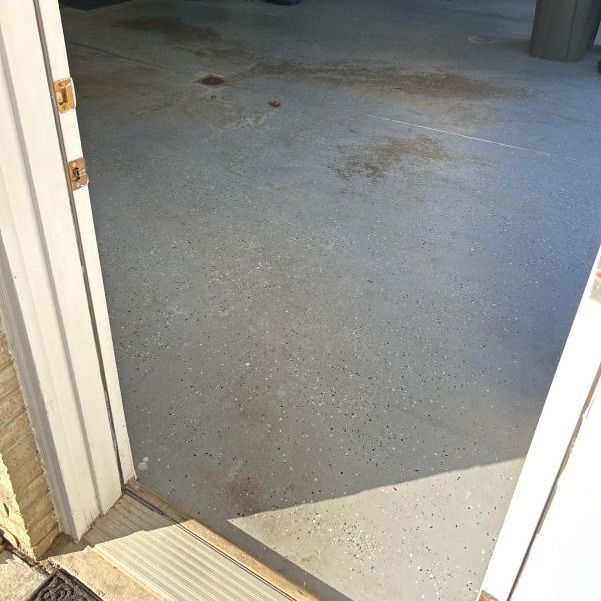
You do not have to spread any salt in your garage for it to end up there. Every winter drive coats your tires with road salt, slush, and brine from treated streets. When you pull in and park, the tires warm up and that salty mix drips and falls onto the concrete, pooling right where you park and near the garage door. Your garage quietly becomes the collection point for a whole season’s worth of road salt, concentrated in the exact spots that see the most traffic. From there, it goes to work on the slab.
Damage #1: salt supercharges the freeze-thaw cycle
Bare concrete is porous, so it soaks up that salty water like a sponge. Salt makes the problem worse in two ways. It is hygroscopic, meaning it draws in and holds even more moisture, so a salted slab stays wetter than a clean one. And it lowers the freezing point of water, which leads to more <a href=”/blog/concrete-freeze-thaw-damage/”>freeze-thaw activity</a> as temperatures hover around freezing. Every time the trapped moisture freezes, it expands and pushes the concrete apart from within. Repeat that through a Western PA winter and you get surface scaling, pitting, and spalling, where thin layers of concrete flake and pop away.
Damage #2: the chemical attack
Salt does not just worsen freezing, it chemically attacks concrete too. The chlorides in de-icing salts, especially calcium chloride and magnesium chloride, react with calcium hydroxide in the cured concrete to form a compound called calcium oxychloride. Those crystals expand as they form, creating internal pressure that cracks and crumbles the concrete from the inside, and this can happen even when it is not freezing. Over a longer time, chlorides that reach any steel reinforcement in the slab corrode it, and the rust expands and cracks the concrete further. This chemical side of salt damage is the part most people never see coming.
The white stains and other warning signs
Salt damage shows itself in a handful of telltale ways. Keep an eye out for:
- White stains or haze. Efflorescence, the chalky white residue left as salty water evaporates and recrystallizes on the surface.
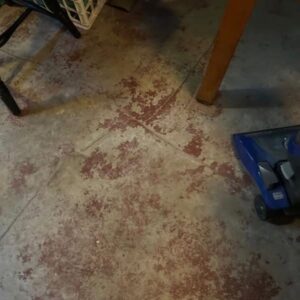
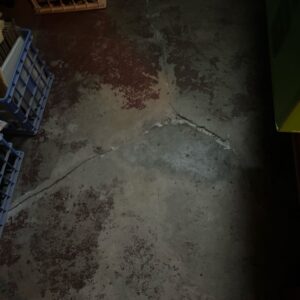
- Surface pitting. Small craters and voids forming across the concret.
- Scaling and flaking. The top layer of concrete peeling or shedding in thin sheets.
- Spalling. Larger flakes and chunks breaking loose, leaving gaps.
- A rough, dusty feel. A surface that used to be smooth turning gritty underfoot, often worst near the door.
If any of these look familiar, the salt has already been working on your floor.
The core problem: bare concrete is porous, so salt and water get inside. Everything salt does to wreck a floor starts with it soaking into the slab.
Why bare concrete is the real issue
Notice that both forms of salt damage depend on one thing: the salt getting into the concrete. The freeze-thaw pressure needs moisture inside the pores. The chemical reaction needs chlorides reaching the minerals in the slab. An unprotected floor lets both happen freely, because porous concrete simply absorbs whatever lands on it. Seal that surface off, and the salt has nowhere to go.
How a coating stops salt damage
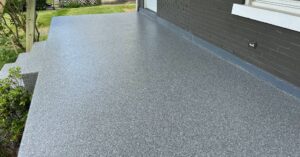
A polyurea and polyaspartic coating creates a seamless, non-porous barrier bonded to the slab. Salt, brine, and meltwater can no longer soak in, so they sit on the surface where you can wipe or mop them away. With nothing penetrating the concrete, the freeze-thaw pressure never builds and the chloride reaction never starts. The coating is also flexible, so it moves with the slab through temperature swings instead of cracking, and the same seal that blocks salt also keeps out the oil and water that stain a bare floor. It is one of the most effective defenses a Western PA garage floor can have against winter.
Already seeing salt damage? Here is what to do
If your floor is already pitted, scaling, or stained, it is not too late, but a coating cannot simply be poured over crumbling concrete. The damaged surface is ground down, and the pits, cracks, and spalled areas are repaired and leveled first, so the coating bonds to sound concrete. Done properly, that turns a salt-eaten floor into a sealed, protected surface that keeps the next winter’s salt out for good. The key is addressing the existing damage as part of the prep rather than coating over it.
Frequently asked questions
Does road salt really damage a garage floor?
Yes. Salt draws moisture into porous concrete and accelerates freeze-thaw cracking, and its chlorides chemically react with the slab to form expanding crystals that break it apart from within.
What does salt damage look like on concrete?
Look for white staining, surface pitting, scaling or flaking, spalled chunks, and a rough, dusty feel, often worst near the garage door where salty water collects.
How do I protect my garage floor from salt?
Seal it. A non-porous polyurea and polyaspartic coating keeps salt and brine on the surface so they wipe away instead of soaking in and damaging the concrete.
Can a salt-damaged floor still be coated?
Yes. The damaged surface is ground down and the pits and cracks are repaired first, so the new coating bonds to sound concrete and seals out future salt.
Seal your garage floor before another salty winter
Road salt does its worst damage quietly, one winter at a time, so the best move is to seal the slab before it starts. As a family-owned local team serving Greater Pittsburgh, Western Pennsylvania, Eastern Ohio, West Virginia, and nearby areas, we repair existing salt damage and install non-porous garage floor coatings that lock salt out for good. If your floor is already cracked or spalling, we can fix that first. Call 724-456-2788 or request a quote to protect your floor.