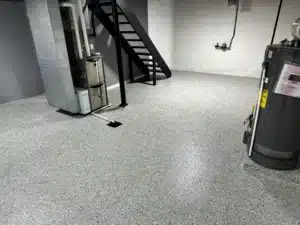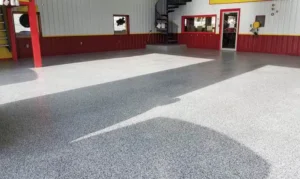

Quick answer: Yes, you can put polyurea over epoxy, but only when the epoxy is fully cured, still tightly bonded to the concrete, and free of cracks or moisture problems. The old floor needs to be mechanically ground or sanded first so the new coating has something to grip. If the epoxy is peeling, chipping, cracked, or moisture is pushing up through the slab, polyurea over epoxy will fail right along with the layer underneath, and the epoxy has to be ground off before anything new goes down.
Sometimes it comes down to the condition of the epoxy. Polyaspartic, which is a type of polyurea, bonds well to an epoxy floor that is fully cured and still tightly stuck to the concrete, as long as that surface is mechanically roughened up and cleaned first. But if the old epoxy is peeling, flaking, chipping, or there is moisture pushing up through the slab, coating over it only buys you a fresh layer that fails right along with the old one underneath. In that case, the epoxy has to be ground off and the floor started fresh. Either way, the outcome is decided by prep, not by the coating.
Here is how to tell which situation you are in.
When You Can Put Polyurea Over Epoxy
Polyurea and polyaspartic are closely related. Polyaspartic is a type of aliphatic polyurea, formulated to give installers more working time. In floor systems it is often the topcoat, and it is known for bonding well to cured epoxy. So when people ask whether polyurea can go over epoxy, the honest, technical answer is that the chemistry is on your side. The question that actually matters is whether the epoxy underneath is sound enough to build on.
Putting polyurea over epoxy can work when all of these are true:
- The epoxy is fully cured. A base layer that has not completely hardened will cause the new coat to bubble or delaminate. Cured and solid is the requirement.
- It is still well bonded. The epoxy needs to be firmly stuck to the concrete across the whole floor, with no loose or hollow-sounding spots.
- The damage is only cosmetic. Light scratching, dullness, faded color, or minor surface wear are all fine to coat over. These are exactly the cases where a fresh polyaspartic layer restores the look and adds real protection.
- It gets proper prep. The old surface has to be mechanically abraded, ground, or sanded to a profile, then vacuumed and cleaned so the new coating can grip. Coating over slick, untouched epoxy is a recipe for peeling.
When those boxes are checked, this kind of coating upgrade is a genuine win. You get a tougher, more UV-stable surface without tearing everything out. This applies whether you’re upgrading a garage floor coating, a basement, or a patio.
When the Old Epoxy Has to Come Off First
Other times, coating over the old floor is the wrong move, and a good installer will tell you so. Adding a topcoat is a mistake when any of the following show up, and the epoxy needs to be removed and the slab taken back to bare concrete instead:
- It is peeling, flaking, or chipping. A topcoat cannot fix a base that is already letting go. It will fail wherever the epoxy underneath fails.
- There are cracks or delamination. A new layer will not hide or bridge cracks in the old coating. Those need to be addressed at the concrete level. If this sounds like your floor, our cracked garage floor coatings page walks through the repair process in more detail.
- Moisture is coming up through the slab. If water vapor is migrating up from below, no topcoat will hold. The moisture issue has to be dealt with first, or any coating will lift. This is a well-documented failure mode: industry testing standards like ASTM F710 moisture vapor testing exist specifically because coating over a wet slab is one of the most common causes of coating failure.
In these situations, grinding the epoxy off is not the installer upselling you. It is the only way to get a floor that lasts.
| Floor Condition | Coat Over With Polyurea? | What Needs to Happen |
|---|---|---|
| Fully cured, well bonded, cosmetic wear only | Yes | Mechanically abrade and clean, then apply polyurea topcoat |
| Not fully cured or partially bonded | No | Wait for full cure or remove and start over |
| Peeling, flaking, or chipping | No | Grind epoxy off down to bare concrete |
| Visible cracks or delamination | No | Repair concrete, then grind and recoat |
| Moisture pushing up through the slab | No | Resolve the moisture source before any coating goes down |
The bottom line: sound, cured epoxy can be coated over after proper prep. Failing epoxy has to be removed. The floor’s condition makes the call, not a general rule about whether the new coating is a good idea in theory.
Why Prep Decides If Polyurea Over Epoxy Will Hold
A coating is only as strong as its bond to whatever is beneath it. That is the whole ballgame. This is why our approach leans on thorough surface preparation and diamond grinding for proper adhesion rather than assuming a quick topcoat will do. Mechanical preparation is the industry-recognized standard for this kind of work; guidelines like the ICRI concrete surface profile system exist because the bond between an old coating and a new one depends on getting that roughened profile right, not on the coating chemistry alone.
On an epoxy floor, that means honestly assessing whether the existing coating is a sound foundation or a liability. If it is solid, we prep it correctly and build on it. If it is failing, we grind it off and start from clean concrete. The goal is the same either way: a finished floor that stays put for years instead of peeling in a season. This same logic applies to basement floor coatings, where moisture is even more likely to be the deciding factor.
Why Homeowners Upgrade From Epoxy to Polyurea and Polyaspartic
Most homeowners asking whether they can put polyurea over epoxy already sense their epoxy is not holding up, and they are usually right. Epoxy tends to yellow and chalk under UV exposure, cures slowly, and is more prone to cracking and peeling over time. Polyurea and polyaspartic are four times stronger than epoxy, stay flexible through temperature swings, resist UV so the color holds, and cure fast enough to finish many floors in a single day.
Whether that upgrade goes on top of your current epoxy or replaces it comes down to the condition of what you already have. For a broader side-by-side comparison of the two materials, our concrete coatings FAQ page covers how polyurea stacks up against epoxy across durability, flexibility, and UV resistance.
Frequently Asked Questions About Polyurea Over Epoxy
Can polyaspartic be applied over epoxy?
Yes, when the epoxy is fully cured, still well bonded to the concrete, and properly abraded and cleaned first. Polyaspartic bonds well to sound epoxy as a topcoat.
What if my epoxy is peeling?
Then it needs to be removed. A new coating over peeling epoxy will fail along with the layer underneath, so the floor should be ground back to bare concrete first.
Do you have to grind the old epoxy?
The surface always needs mechanical prep. Sound epoxy is abraded to create a profile the new coat can grip, while failing epoxy is ground off entirely.
Is polyurea better than epoxy?
For most garage and concrete floors, yes. Polyurea and polyaspartic are stronger, more flexible, more UV-stable, and faster to cure than epoxy.
How do you know if your epoxy is a good candidate for a polyurea topcoat?
Check for three things: full cure, solid adhesion with no hollow or loose spots, and damage that’s only cosmetic. If all three hold true, polyurea over epoxy is usually a safe upgrade once the surface is properly ground and cleaned.
Get a Straight Answer on Polyurea Over Epoxy for Your Floor
The only way to know for sure whether your floor is a good candidate for this upgrade is to have someone look at its actual condition. As a family-owned local team serving Greater Pittsburgh, Western Pennsylvania, Eastern Ohio, Morgantown, West Virginia, and nearby areas, we will assess your epoxy honestly and prep it the right way, whether that means coating over it or starting fresh. Call 724-456-2788 or request a quote to get a straight answer on your garage floor coating.