Both can make a great basement floor, but for most older Pennsylvania homes, a seamless concrete coating is the more practical choice. It bonds directly to your slab, seals out surface moisture with no grout lines for mold to grow in, and flexes with a slab that shifts through freeze-thaw winters. Tile is a beautiful, water-resistant, and durable option, and it shines on a floor that is flat, dry, and sound. The catch in an older PA basement is that the slab often is not any of those things, and that is where tile runs into trouble. Here is how the two compare so you can pick the right one for your space.
Why older PA basements are tricky
Basements in older Pennsylvania homes come with a few built-in challenges that shape which flooring actually works. The slab is usually decades old, so it tends to be uneven, cracked in spots, and rarely perfectly level. It sits below grade against damp soil, which means moisture vapor rises up through the concrete and humidity runs high. And our freeze-thaw winters cause the slab to expand and contract, so it is never entirely still. Any floor you put down there has to deal with moisture and a slab that moves. That single fact decides a lot.
Tile in a basement: the honest pros and cons
Porcelain and ceramic tile are a classic, good-looking choice, and there is plenty to like.
What tile does well: the tile surface itself is water-resistant and durable, it comes in nearly endless styles, it handles a genuinely wet room like a bathroom, and a single cracked tile can be replaced without redoing the floor.
Where tile struggles in an older basement: tile needs a flat, sound substrate, so an uneven or cracked old slab usually has to be leveled first, which adds cost and labor. The grout lines between tiles are porous, so they absorb moisture and can grow mold or show efflorescence in a damp basement. And because tile and grout are rigid, a slab that moves with freeze-thaw can crack the grout or make tiles pop loose over time. Tile is also cold and hard underfoot, which matters in a room you want to actually spend time in.
Concrete coatings in a basement: pros and cons
A polyurea and polyaspartic coating takes a different approach, bonding to the slab instead of sitting on top of it.
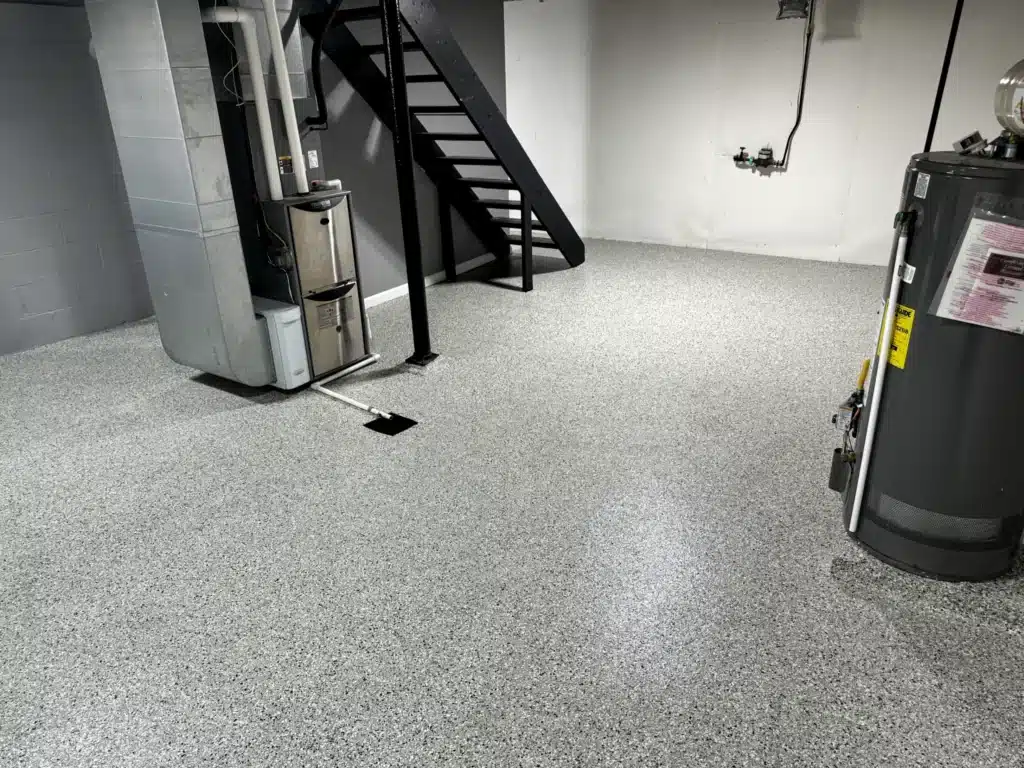
What a coating does well: it is seamless, so there are no grout lines anywhere for moisture or mold to collect. It creates a non-porous, moisture-resistant surface sealed right to the concrete. It stays flexible, so it moves with the slab through temperature swings instead of cracking. Minor slab imperfections and cracks get repaired as part of the prep rather than needing a full leveling job. It is slip resistant even when damp, unlike a slick tile surface, and it cleans up with a quick sweep or mop. Most basements are done in a single day.
The tradeoffs: like tile, a coating is firm underfoot rather than soft and warm, though area rugs handle that easily. It also calls for professional installation to get the prep right. And one honest point that applies to any basement floor: a coating seals against surface moisture and vapor, but it is not a substitute for foundation waterproofing. If your basement has active water coming in, that source has to be addressed first.
The heart of it: tile fights a damp, moving slab with rigid pieces and porous grout, while a seamless coating bonds to that same slab and moves with it. In an older basement, that difference is everything.
Concrete coating vs tile, side by side
| Factor | Concrete coating | Tile |
|---|---|---|
| Seams and grout | Seamless, no grout | Grout lines can trap moisture and mold |
| Moisture handling | Non-porous seal bonded to slab | Tile resists water, grout does not |
| Uneven or cracked slab | Repaired during prep | Usually needs leveling first |
| Slab movement | Flexes with the concrete | Can crack grout or pop tiles |
| Underfoot | Firm, slip resistant | Firm, hard, and cold, can be slick |
| Cleaning | Sweep or mop | Scrub grout lines |
| Install time | Often one day | Multi-day, especially with leveling |
| Repairs | Recoat as needed | Replace individual tiles |
Which one fits your basement?
Tile makes sense if your slab is already flat, dry, and in good shape, and you have your heart set on a specific tiled look or a particular room that gets genuinely wet. For the more common older PA basement, with an uneven, damp, seasonally shifting slab, a seamless coating solves the exact problems that give tile trouble down there. It handles the moisture, works with the slab you already have, and turns a space people avoid into a clean, dry, usable room. Start by looking honestly at your slab’s condition, because that, more than the look you want, points you to the right floor.
Frequently asked questions
Is a concrete coating better than tile for a basement?
In most older PA basements, yes, because it is seamless, seals surface moisture, and flexes with a moving slab. Tile can be the better pick on a flat, dry, sound slab or for a specific look.
Why is grout a problem in a basement?
Grout lines are porous, so in a damp basement they can absorb moisture and grow mold or show white efflorescence. A seamless coating has no grout at all.
Can you coat an old, uneven basement slab?
Yes. Cracks and minor imperfections are repaired and the surface is ground and prepped before coating, so an older slab usually does not need full leveling the way tile does.
Will a coating fix a wet basement?
It seals against surface moisture and vapor, which handles most damp basements. Active water intrusion has to be diagnosed and addressed first, since a coating is not foundation waterproofing.
Find the right basement floor for your older PA home
The best flooring choice starts with a look at your actual slab and how you want to use the space. As a family-owned local team serving Greater Pittsburgh, Western Pennsylvania, Eastern Ohio, West Virginia, and nearby areas, we will assess your basement honestly and walk you through color options if a coating is the right fit. Call 724-456-2788 or request a quote to explore a seamless basement floor coating.